PARA ATHLETE


.jpg)
ABOUT
Every person has a moment that has defined his or her life. It’s that one moment in time - good or bad - that has set the course of your life and defined who you will become. For me, that moment occurred on January 20, 1991. It was the moment that I heard the words “you have cancer.”
I was 11-years-old. At the time, I knew very little about cancer. I knew that my great-grandmother had breast cancer and she died. I knew that both my grandfathers had cancer and they died. To me, cancer was death. This was reinforced when the attending doctor coldly told my parents to take me home and wait for the end. He optimistically told my mom and dad that death, though painful, shouldn’t take long. In fact, he said, it shouldn’t take more than six weeks.
When you’re an 11-years-old just diagnosed with cancer, six weeks seems like an eternity. When I was released from the hospital, I returned home, crawled into bed, and opened my school calendar. I flipped through the pages, counting out the weeks before I was supposed to be gone. I was excited to celebrate on more Valentine’s Day. Maybe I would get a chance to go sledding one more time. Maybe I could even visit my grandmother’s camp and step on the frozen lake just once more. Soon, though, my fingers were touching the days I would no longer be here. They pointed out all the things I would miss - Easter dinner with my family, my 12th birthday, my little sister heading off to kindergarten. I would never go to high school; never go to prom; never drive a car; never get married; never see my sister graduate. There were too many “nevers.” I was in sixth grade and had many friends, but would they come to my funeral? Did they make caskets that small? Would my family still love me when I was just a memory?
I wanted more. I wanted more time. I wanted to do more. I wanted to be more.
When you’re the parents of an 11-year-old just diagnosed with cancer, six weeks seems like a millisecond. My parents desperately sought a second opinion, and when they were given the same prognosis, they sought a third. We traveled to Boston where we were told the cancer diagnosis was correct, but the prognosis was not. For the first time, I was given a chance to fight.
Cancer changed me. Cancer made me stronger. It made me a fighter. It made me committed to finding a cure. Who I am now was defined by who I became then. Giving up was never an option.
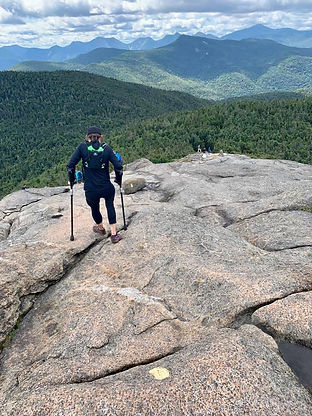
One of the long-term effects of my diagnosis is that I’ll spend my lifetime dependent on mobility aids, but I know that no matter what happens,
I’ll adapt and overcome.
SNAPSHOTS


Email: devann.murphy@gmail.com